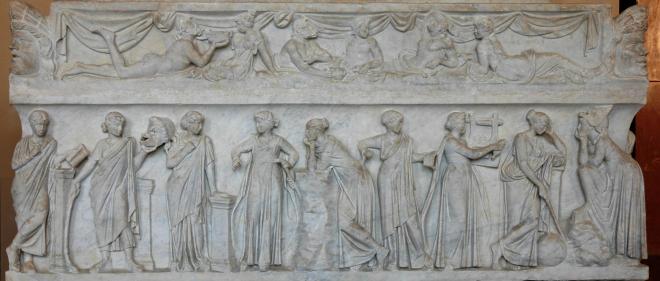
I Kalliope
I wonder if Kalliope thinks us
fools; we watch our TVs, and as we sit,
she looks down at her tablet and stylus
where all the heroes of old flit.
Herakles, Achilles, Orpheus scrawled
across stone while Kardashians
fill our screens, their petty fights a thrill.

II Kleio
If Kleio walked among a lab today,
pristine white benches full of test tubes
and syringes, would she think about
how we receive a simple cheek swab—
just some strands of DNA—and can now
understand the parts of history unseen:
the places our ancestors have been.

III Erato
Does sweet Erato spurn the way
we have made love a competition to be won?
The number of possible lovers halved,
one rose to give—there can be only one.
Edward or Jacob: does she join the fun
and choose a team to be on, or does she
believe this is not how love should be?

IV Euterpe
The bass thrums through our bodies as our hearts
learn to beat in time, so different now
than when classical notes guided our ancestors
to dance in rows and begin with a bow.
Would they have known Euterpe’s furrowed brow
as she played her aulos, a double flute?—
What’s that?—Does she think the question cute?

V Melpomene
The tragic face of Melpomene stares
at those oppressed by the big black dog of
sorrow, she watches them shoot up in pairs,
the overdose in full swing as they shove
the needle in, far from the star-crossed love
and disasters of old—no more Trojan
Wars, just another wretched, broken soul.

VI Polymnia
As the words and languages of hymns change,
does Polymnia’s voice remain the same? Or
is she able to reach a whole new range
with a microphone helping her notes soar
instead of having to push them back to the door?
Do the recording studios today
feel like the temples where she used to play?

VII Thaleia
To laugh has always been the best of ways
to keep our tears at bay, but now we find
great humour in one’s pain; how many days
do tiktoks and vines numb the mind—
kids falling, a truckie swearing in line.
I wonder if Thaleia laughs or thinks us cruel,
her domain no longer just a stage and a fool.

VIII Terpsikhore
Oh, how I wish to see the old dances,
worshipping gods past—did Terpsikhore dance
with them? Does she dance with us? We take chances
with grinding, trying to be everyone’s first glance;
does she miss the ballroom’s reserved advance?
Would she prefer us as steady as back then,
or does she like the speed of this new trend?

IX Ourania
I wonder if we would pay greater heed
to stars if they began to dance; would we
turn off our lights so we could watch them bleed,
or brighten them so we still could not see
them twinkle above our little world, free,
and does Ourania point to her bright globe,
reminding us of what is lost with just one probe?
Image by Egisto Sani

